Delivery day
Marc, 72, has just signed the purchase of his first Aixam at the dealership. The salesperson hands him the keys, explains a couple of things about charging, then passes him a folder of papers. “The registration document is up to you. You have 30 days.” Marc goes home. The folder stays on the kitchen table for a week.
This moment of hesitation is universal. Registering a vehicle seems simple until the moment you tackle it. For a license-free car, there are a few specifics to know before starting the process.
Which legal category for your license-free car?
Before talking about the procedures, a word on the official nomenclature. License-free cars belong to two categories of motor quadricycle defined by European regulations:
L6e, light quadricycle
This is the category of the vast majority of license-free cars on the road:
- Unladen mass less than or equal to 425 kg (excluding batteries for electric models)
- Maximum speed of 45 km/h
- Engine displacement less than or equal to 50 cm³ (petrol) or power less than or equal to 4 kW (electric)
- Examples: Citroën AMI, Aixam City, Microcar M.Go, Ligier JS50
L7e, heavy quadricycle
Less common, reserved for more powerful vehicles:
- Unladen mass less than or equal to 600 kg (excluding batteries)
- Engine power less than or equal to 15 kW
- Accessible with the category B licence only (not the AM licence)
- Examples: certain top-of-the-range Ligier models, the electric Piaggio Porter
In both cases, the registration procedure goes through the Vehicle Registration System (SIV) managed by the ANTS (National Agency for Secure Documents).
New vehicle: the procedures step by step
For a new vehicle bought from an approved dealer, the process is relatively simple. Many dealers offer to handle it for you, for a processing fee (generally between 50 and 150 €). If you prefer to do the procedures yourself, here is the path.
The documents to gather
- The European certificate of conformity (COC), supplied by the manufacturer/dealer, it certifies that the vehicle complies with European technical standards
- The Cerfa 13749*05 form (application for a registration certificate), available at the prefecture or on the ANTS website
- Proof of identity, a valid national identity card or passport
- Proof of address less than 6 months old, an electricity bill, a rent receipt, or failing that a proof of accommodation with the host’s supporting document
- Payment of the tax, by bank card on ants.gouv.fr
The online procedure on ants.gouv.fr
The ANTS has digitised most of the procedures. Everything happens on ants.gouv.fr in the “Registration certificate” section. It is no longer possible to go directly to the prefecture for a registration document request since 2017, except in special cases (people without internet access, complex old vehicles).
You create an account, upload the digitised documents, pay online, and receive a registration acknowledgement that lets you drive legally for one month.
Used vehicle: what changes
Buying a used license-free car involves additional steps.
The documents the seller must give you
- The registration certificate (vehicle registration document) with the words “Sold on [date]” signed by the seller
- The transfer certificate (Cerfa 15776*01 form), a document that formalises the transfer of ownership, to be filled out in two copies (one for each party)
- The roadworthiness test, for combustion license-free cars more than 4 years old, a roadworthiness test less than 6 months old is mandatory for the sale. Note: this point is often overlooked for license-free cars, but it does apply
The administrative status certificate (no-lien)
Before buying, always ask the seller for an administrative status certificate (CSCA, formerly called a “no-lien certificate”). It proves that the vehicle is not subject to a lien and that there is no objection to the transfer of ownership. This document is free and available on the histovec.interieur.gouv.fr website. It is mandatory if the vehicle is less than 5 years old.
Transfer declaration within 15 days
The seller is obliged to declare the transfer of the vehicle on the ANTS website within 15 days following the sale. In practice, check that this has been done: as long as this declaration is not registered, any offences committed by the new owner can be traced back to the previous one.
For you, the buyer, you have one month from the transfer date to apply for the registration document in your name.
How much does a registration document cost for a license-free car?
This is one of the nice surprises of owning a license-free car.
The cost of a registration certificate is calculated based on the number of fiscal horsepower (fiscal CV) of the vehicle. A license-free car has very low engine power, so it is systematically classified at 1 fiscal CV.
The regional tax is set by each region. In 2025, the most common rate is around 4.50 to 5.50 € per CV. For 1 CV, that gives a regional tax of less than 6 €. Adding the other components (professional tax, delivery fee), the total cost of a license-free car registration document is generally between 11 and 16 €, compared with 200 to 400 € for a normal car.
For electric license-free cars, additional exemptions apply in most regions: the regional tax is reduced to zero or cut by 50%, depending on the regional rules in force.
Timeframes
Once your complete file is submitted to the ANTS, you receive:
- Immediately: a printable registration acknowledgement, valid for 1 month to drive
- Within 3 to 5 days: an email confirmation with the production tracking number
- Within 3 to 4 weeks: the physical registration document, sent by secure post (registered letter) to your address
If your file is incomplete or an additional document is requested, the timeframe can lengthen. The ANTS has an online tracking area to check the progress of your application.
If you need the vehicle quickly and you are travelling through a region different from the one of registration, the registration acknowledgement is accepted everywhere in the country.
Frequent points to watch
The Cerfa 13749 form has a “Type” box for the vehicle. For a license-free car, you must enter “QUAD” or “QM” (light motor quadricycle), not “VP” (passenger car). Some forms pre-filled by dealers contain errors on this point.
The holder’s name must match exactly the identity document provided. A discrepancy (abbreviated first name, missing particle) can lead to the file being rejected.
For license-free cars bought abroad (used from Belgium, Italy, etc.), the procedure is different: you first need to obtain a tax receipt, then go through an individual approval (RTI) if the vehicle is not covered by a European homologation recognised in France. Seek advice from an approved professional in this case.
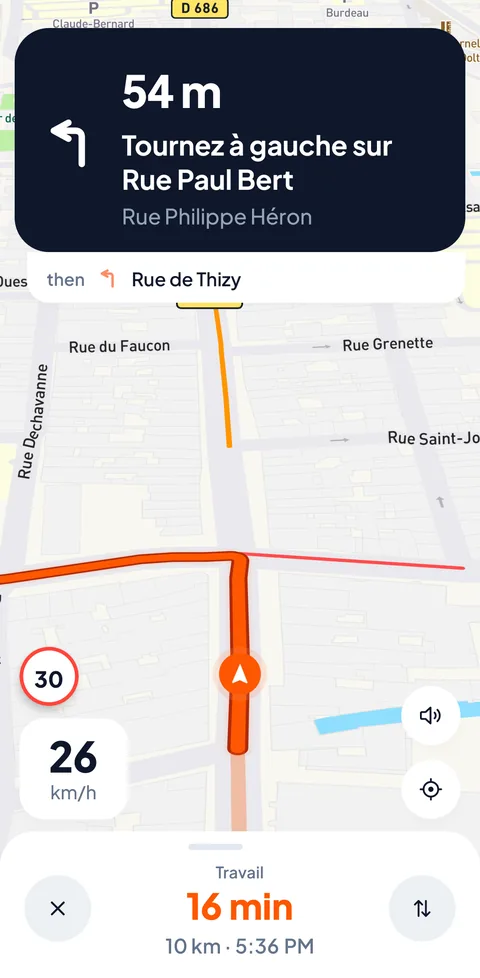
Once your vehicle is registered and on the road, the question of a GPS suited to 45 km/h quickly arises. Waze and Google Maps calculate routes designed for normal cars: unfiltered roads, false ETAs, guidance calibrated for 90 km/h. TacTac is the app designed specifically for license-free cars: filtered L6e routing, reliable travel times, live community alerts. Available on iOS and Android.