“I was flashed at 52 km/h in my license-free car”
Karim, 19 years old, lives in Montluçon. He has been driving a second-hand Microcar M.Go for six months. One weekday evening, he passes an educational speed radar: 52 km/h. He does not understand. His speedometer showed 44 km/h. He did not think he had accelerated.
This scenario is not rare. The combination of a license-free car speedometer that underreads actual speed and a limited knowledge of the rules means many license-free car drivers find themselves breaking the law without realising it. Here are the rules that apply, without approximation.
The legal limit: 45 km/h, non-negotiable
License-free cars belong to the regulatory category L6e (motorised light quadricycles). This European classification imposes a manufacturer maximum speed of 45 km/h. That ceiling is written into Directive 2013/168/EU and transposed into French law.
It is not a recommendation or an optional safety limit. It is the legal maximum speed for the category. An Aixam, a Ligier, a Microcar: every model sold in France is factory-limited to 45 km/h. Removing the limiter means breaking the law.
De-restricting: concrete risks
Some workshops offer to de-restrict license-free cars to reach 60 or 70 km/h. Beyond the reclassification as a non-type-approved vehicle, driving a de-restricted license-free car:
- Voids insurance in the event of an accident (the policy covers an L6e, not a modified vehicle)
- Exposes the driver to a 1,500-euro fine for non-compliance
- Creates criminal liability in the event of a personal-injury accident
Forbidden roads: the 70 km/h rule
License-free cars may use all roads open to traffic except:
- Motorways (blue signs, specific signage)
- Expressways (marked with signs bearing a specific pictogram)
- Any road with an imposed minimum speed above 45 km/h
That last point is often poorly understood. Some national roads and dual carriageways display a minimum speed of 70 km/h. A license-free car is formally forbidden there, even if the road is not a motorway in the strict sense. The fine for driving on a road forbidden to light quadricycles can reach 1,500 euros, with possible vehicle immobilisation.
On ordinary roads, departmental roads, national roads without an imposed minimum speed, and urban streets, the license-free car is perfectly permitted. Travelling at 45 km/h on a road limited to 80 km/h is legal, even if it is uncomfortable for drivers behind you.
The license-free car speedometer: an imprecise instrument
That is Karim’s problem. License-free car speedometers are notoriously optimistic, in the sense that they display a speed lower than the actual speed. The margin varies by model, but it commonly runs between +5 and +10 km/h compared to the true reading.
In other words: a license-free car whose speedometer shows 42 km/h may actually be travelling at 47 or 48 km/h.
Why? Manufacturers configure the speedometer with a deliberately conservative tolerance to ensure the driver stays under the legal limit, in theory. In practice, factory calibrations vary, tyre wear changes the rolling circumference, and some models are more accurate than others.
How to check your actual speed
The GPS app on your phone, which uses the GPS signal to calculate actual ground speed, is more reliable than your mechanical or electronic speedometer. If your GPS regularly shows 47 to 48 km/h when your speedometer reads 44 km/h, the GPS figure corresponds to your actual speed.
The penalties: 135-euro fine for exceeding the limit
In France, exceeding the maximum permitted speed for your vehicle category is penalised like any standard speeding offence. The scale applied for an excess of less than 20 km/h on the road, which covers most situations for a license-free car, is a fixed fine of 135 euros.
Contrary to some beliefs, driving a license-free car does not create a special penalty regime. A fixed or mobile speed camera captures your speed and the offence is processed the same as for any other vehicle.
The AM licence (required for drivers born after 1 January 1988) has carried penalty points since 2013. A speeding ticket therefore results in a point deduction, in addition to the fine.
License-free car vs moped: same rules, same speed
Many license-free car drivers rode mopeds or 50cc scooters before moving to a microcar. The speed rule is identical: 45 km/h maximum for mopeds (L1e-B) and light quadricycles (L6e).
The difference is not in speed, but in:
- Protection (a license-free car has a body, a seatbelt, and airbags on some recent models)
- Footprint (a license-free car is around 1.5 m wide, a scooter around 50 cm)
- Stability (four wheels versus two, especially during emergency braking or cornering on a wet surface)
Particular care on national roads
National roads with one lane in each direction, limited to 80 km/h, are legally accessible to license-free cars. However, they concentrate risk for one simple reason: the speed differential between your license-free car and other vehicles is at its greatest there.
At 80 km/h on one side and 45 km/h on the other, the 35 km/h differential makes overtaking considerably more complex. On a narrow road with limited visibility, it is dangerous.
Prudent rules to apply on national roads:
- Keep as far right as possible to make overtaking easier
- Use passing places or road widenings to let a queue of vehicles through
- Avoid rush hours on these routes
- Prefer routes through villages and secondary departmental roads
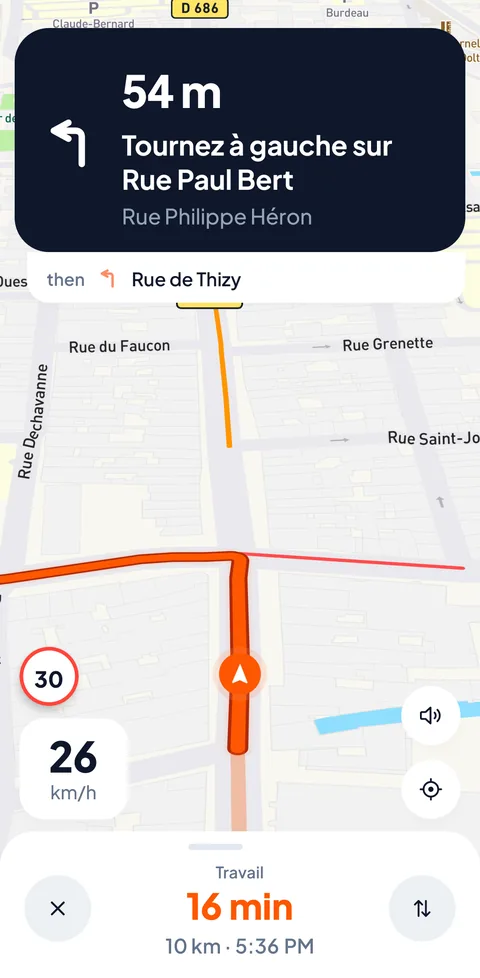
A GPS calibrated for license-free cars will automatically suggest alternatives that avoid these routes while staying on permitted roads. That is precisely what TacTac does: calculate a route adapted to your actual speed, excluding dangerous or forbidden roads.
What law enforcement officers check
During a roadside check, officers may verify several points specific to license-free cars:
- Vehicle compliance: the type-approval number must correspond to an unmodified L6e model
- Registration document: a license-free car must have a carte grise like any other vehicle
- Insurance: compulsory, even at 45 km/h
- AM licence: compulsory for drivers born after 1 January 1988
Speed is generally not checked during a physical stop; it is monitored by automatic cameras.
FAQ
Will a speed camera flash me if I am doing 47 km/h in a license-free car?
Automatic speed cameras apply a technical tolerance of approximately ±5 km/h at low speeds. A camera recording 47 km/h on a road limited to 45 km/h is unlikely to generate a fine. But that tolerance is not a right: it may vary depending on the camera type. The principle remains: stay below 45 km/h in real terms.
Is a license-free car GPS more reliable than a dashboard speedometer?
For actual ground speed, yes. The GPS calculates speed by satellite triangulation, independently of the vehicle’s mechanics. That is also the value seen by automatic speed cameras.
Can I drive in a bus lane in my license-free car?
No, unless local signs indicate otherwise. Bus lanes are reserved for public transport (and sometimes cyclists or taxis, depending on the markings). A license-free car is not permitted there by default.
In summary
The 45 km/h limit is not a suggestion: it is the legal definition of your vehicle category. Your license-free car speedometer is often optimistic by 5 to 10 km/h. Roads with an imposed minimum speed above 45 km/h are forbidden. Driving too fast in a license-free car is penalised the same as for any other vehicle: 135 euros minimum.
To navigate safely on roads suited to your actual speed, join the TacTac waiting list, the GPS that calculates your routes at 45 km/h, not at 90.