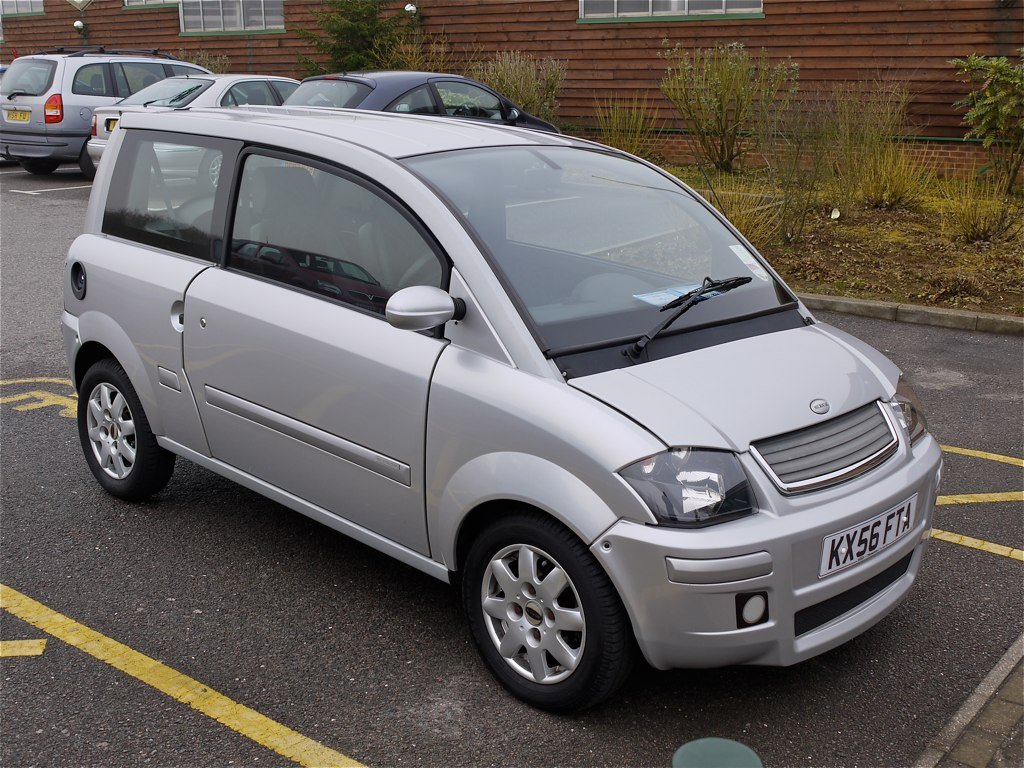
People who search for a “4 seater licence free car” usually picture a 28 mph microcar that a teenager or a driver without a full licence could use to carry the whole family. European type-approval law does not allow that vehicle. Something close to it exists, but it comes with a different licence.
4 seater licence free car: why the law rules it out
What the French call a voiture sans permis is, in legal terms, a light quadricycle, category L6e. Annex I of Regulation (EU) No 168/2013, which sorts every L-category vehicle and remains part of the law of Great Britain, sets the limits: a top speed of 45 km/h (28 mph), a mass in running order of 425 kg, and a maximum of two seating positions, including the driver. No family version, and no exemption for children.
As soon as a manufacturer adds a rear bench, the vehicle leaves L6e. It becomes a heavy quadricycle, category L7e, and more precisely an L7e-CP (heavy quadri-mobile for passenger transport), the only sub-category allowed up to four seats, driver included. That vehicle requires a proper licence everywhere in Europe.
Quadricycle 4 seats: light L6e vs heavy L7e
| Criterion | L6e, light quadricycle | L7e, heavy quadricycle |
|---|---|---|
| Seats | 2 maximum, driver included | up to 4 in L7e-CP |
| Maximum design speed | 45 km/h (28 mph) | 90 km/h (56 mph) for L7e-C |
| Maximum power | 6 kW for enclosed models (L6e-B) | 15 kW |
| Mass in running order | 425 kg | 450 kg (passengers), 600 kg (goods) |
| Licence in Great Britain | AM, from 16 | B, from 17 |
| Licence in France | AM from 14, or none if born before 1 January 1988 | B1 from 16, or B |
Sources: Annex I of Regulation (EU) 168/2013 for the technical limits; Road Traffic Act 1988 section 101 and the Motor Vehicles (Driving Licences) Regulations 1999 for Great Britain; articles R211-2, R221-4 and R221-5 of the French Highway Code for France.
Not every L7e has four seats. The utility version (L7e-CU) and on-road quads carry two people at most. The 600 kg ceiling applies only to goods vehicles; a heavy quadricycle built for passengers stays capped at 450 kg in running order.
What licence for a 4 seat quadricycle in the UK
The GOV.UK page on licence categories places light quadricycles in category AM: mass in running order up to 425 kg, design speed between 25 and 45 km/h. Under section 101 of the Road Traffic Act 1988, as amended by regulation 9 of the 1999 Regulations, AM is open from 16.
A heavy quadricycle is not in AM. Schedule 2 of the 1999 Regulations defines category B as motor vehicles up to 3.5 tonnes other than those in categories Q, AM, A, F or K, so a four seat L7e is driven on an ordinary car licence. The minimum age is 17, lowered to 16 for people receiving the enhanced rate mobility component of Personal Independence Payment.
Readers who remember the B1 licence are not wrong. GOV.UK still lists B1 (four-wheeled vehicles up to 400 kg unladen, or 550 kg for goods), but since 19 January 2013 the regulations call it a “former sub-category B1”, kept by drivers who already hold it. A new driver in Great Britain gets a heavy quadricycle through category B. Northern Ireland has its own licensing rules, so check with the DVA there.
If you live in France
The rules differ, and they are more favourable to teenagers. Article R221-4 of the French Highway Code states that category B1 covers “véhicules de la catégorie L7e”, and article R221-5 sets its minimum age at 16. According to the Service-Public page on the B1 licence, candidates sit the general theory test and a practical test of about 32 minutes.
A B licence holder needs nothing more, because article 6 of Directive 2006/126/EC makes category B valid for B1. The French exemption for people born before 1 January 1988 (article R211-2) covers light quadricycles only, never an L7e. And article R421-2 bars all motor quadricycles, light or heavy, from French motorways. Our article on roads closed to licence-free cars lists the other restrictions.
Before buying a 4 seat microcar
The range of four seat heavy quadricycles is small and changes quickly, so a list of models would date within months. Four checks on the vehicle itself are more reliable:
- the vehicle category on the registration document (field J), which should read L7e;
- the number of seats including the driver (field S.1);
- the licence of whoever will drive it: B in Great Britain, B1 or B in France, never AM alone;
- an insurance quote for that exact vehicle, giving its category.
A seller who describes a four seater as “licence-free” is mistaken, or the car is approved for two seats and the bench was added afterwards. In that second case, driving with four on board means carrying more passengers than the registration allows. Our guide to licence-free car insurance explains what policies cover, and the minimum age by country page compares the rest of Europe.
A 56 mph quadricycle and route planning
Faster than a light quadricycle but well short of a car, an L7e sits between two worlds: quick enough to be held up behind 28 mph microcars, too slow to merge comfortably into fast A-road traffic. TacTac plans routes by vehicle profile, L6e or L7e, favouring suitable secondary roads and showing realistic journey times.