
Holidays in Spain With a Microcar
Dominique, 61, lives in Perpignan and uses his Microcar M.Go every day. As summer approaches, he is wondering: can he cross the border with his license-free car to visit family in Barcelona? Is it legal? What documents does he need? Can his insurer confirm coverage?
This question affects many license-free car drivers who live near a border or plan to travel. The answer is nuanced: yes, it is possible in many European countries, but with significant differences depending on the destination.
The General Rule Within the European Union
French license-free cars are registered as L6e light quadricycles under European nomenclature (Directive 2013/168/EU). This category is recognised at the European level, but how it is treated on the road varies from one country to another.
The basic principle is free movement of vehicles registered in a member state: a vehicle approved and registered in France can travel in other EU countries using its French documents, provided local rules are respected.
Documents you must carry:
- National identity card (or passport)
- Registration document (carte grise)
- Green card insurance certificate (international attestation)
- AM licence if you were born after 1 January 1988
The green card, issued by your insurer, is your international insurance certificate. It covers all EU countries (and several non-EU countries listed on the back). Check before leaving that your green card is current.
Friendly Countries: Belgium, Spain, Portugal
Belgium
Belgium fully recognises the L6e category. License-free cars are permitted on the same roads as in France (no motorways or expressways). The French AM licence is valid there. Local speed limits apply (30 km/h in 30-zones, 50 km/h in built-up areas, 70 km/h outside built-up areas, though your license-free car is in any case limited to 45 km/h).
Drivers living near the Belgian border (Nord, Ardennes) regularly use their license-free cars in Belgium without any administrative difficulty.
Spain
Spain recognises the L6e category (quadriciclos ligeros in Spanish). Vehicles in this category are permitted to use public roads. The French AM licence is recognised across the EU and therefore valid in Spain.
One Spanish quirk: certain autonomous communities have additional regulations on tourist or mountain roads. In major cities such as Barcelona or Madrid, air-quality traffic restrictions (low-emission zones, ZBE) apply, so check that your license-free car is compatible with the zone of the city you plan to enter.
For a holiday trip from Perpignan to Barcelona: the route is accessible by license-free car via the N-II (coastal road, non-expressway), provided you plan your stops (roughly 200 km at 45 km/h = 5 to 6 hours of driving).
Portugal
Portugal also recognises L6e light quadricycles (quadriciclos leves). The rules of the road are equivalent to France: no motorways, no expressways, open roads permitted. The AM licence is valid.
Portugal is a feasible holiday destination for license-free car drivers who live near the Iberian border, as long as routes are planned carefully.
Restrictive Countries: Germany Is a Special Case
Germany is the most restrictive country in Europe for French license-free cars. The European L6e category has no direct equivalent recognised under German law. German authorities do not issue driving licences for this category and do not approve these vehicles for road use.
In practice, driving a French license-free car in Germany can lead to police checks and potentially to the vehicle being impounded. It is best to avoid Germany with a license-free car, unless you have written confirmation from your insurer and from the German transport authority (BMVI) for your specific model.
This situation is an anomaly within the European single market. Harmonisation efforts are under way, but as of the publication date Germany remains a country to avoid.
Other Countries to Check
- Italy: the L6e quadricycle category is recognised, but urban rules in major cities (ZTL restricted traffic zones) can complicate access to historic centres. Check ZTL zones before your trip.
- Switzerland: not an EU member but part of Schengen, Switzerland has its own type-approval rules. French L6e license-free cars are not automatically recognised. Contact the OFROU (Federal Roads Office) if you plan to travel there.
- Luxembourg and Netherlands: L6e recognition, rules comparable to Belgium. No documented issues.
Insurance: The Green Card Covers the EU
Your French car insurance includes a green card (international insurance certificate). This card is valid in all EU member states and in countries that have signed the international convention (listed on the back of the card, typically 46 countries).
Key points to verify with your insurer before leaving:
- Is your coverage identical abroad? Some policies reduce cover to third-party liability only outside France. Check whether your comprehensive cover also applies.
- Is there a cap on the length of stay? Some policies limit cover outside France to 30 or 90 consecutive days.
- Your insurer’s emergency number (usually a 24-hour assistance line): keep it in your glove box.
If your insurer cannot confirm coverage in the destination country, consider taking out a temporary extension before you leave.
The AM Licence Abroad: Valid Across the EU
The AM licence issued in France is a European Community licence under Directive 2006/126/EC. It is recognised in all EU member states.
For drivers born before 1 January 1988 (who do not need the AM licence in France), the situation abroad may differ: check the local requirements of the destination country for light quadricycles driven without a licence.
Practical Example: Planning a Holiday in Spain With a License-Free Car
Before you leave:
- Check that the green card is current and covers Spain
- Make copies of all documents (registration, insurance, licence)
- Plan your route on suitable roads (avoid autopistas)
- Calculate your stages: 45 km/h over a maximum of 6 hours’ driving per day = 270 km per stage
- Identify charging points (for electric license-free cars) along the route
- Check Barcelona’s low-emission zones if you are entering the city
On the road:
- Local rules for parking, right-of-way, and traffic circulation apply
- At a police check: present registration document, AM licence, and green card
- Road signs are generally easy to read (harmonised European panels)
What TacTac Will Bring for Cross-Border Travel
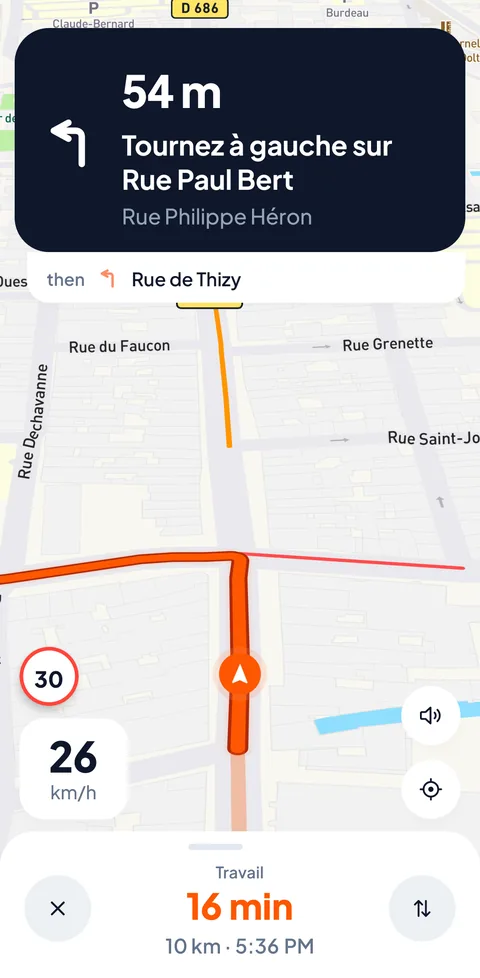
Navigating by license-free car abroad with a standard GPS creates the same problems as in France: routes on roads that are too fast, incorrect ETAs, roads not suited to light quadricycles. TacTac is designed to calculate routes at 45 km/h on roads suited to light quadricycles, a feature that is just as useful abroad as it is in France.
Join the TacTac waiting list and plan your next license-free car holiday without any nasty surprises.
FAQ
Can I drive a French license-free car in Switzerland?
As Switzerland is not an EU member, European L6e type-approval rules do not apply automatically. Contact the OFROU (Switzerland) before any trip. In practice, many border-area drivers travel there without difficulty, but the legal position is less clear than within the EU.
Does my insurance cover an accident in Spain?
If your green card is valid and Spain is listed on it, third-party liability is covered. Check with your insurer whether comprehensive cover extends abroad and for how long.
Is the French AM licence valid in Belgium?
Yes. The AM licence is a European Community licence recognised in all EU member states, including Belgium.
Should I notify my insurer before travelling abroad in a license-free car?
It is recommended, to confirm coverage. Some insurers require advance notification for extended stays. Your insurer may also provide additional certificates in the language of the destination country.