2026: The Year Electric Tipped the Scale for License-Free Cars
Something significant is happening in the license-free car world in 2026. For the first time, electric models are outselling petrol ones by volume in France. This is not accidental; it is the convergence of three decisive factors: the expansion of low-emission zones (ZFE) in major urban areas, fuel prices that have not dropped below 1.80 euros/litre, and regional subsidies that bring electric within reach.
If you are thinking of buying or replacing your license-free car, the question is no longer really “electric or petrol?”. It has become “which electric should I choose?”. This guide gives you everything you need to decide.
Why Go Electric in a License-Free Car?
Crit’Air 0: Complete Freedom in the City
This is the killer argument in 2026. Paris, Lyon, Bordeaux, Grenoble, Strasbourg: all of France’s major cities have tightened their low-emission zone restrictions. An electric license-free car automatically earns the Crit’Air 0 sticker, the only one that guarantees unrestricted access, including during pollution peaks when even Crit’Air 1 vehicles are turned away. For license-free car drivers who use their vehicle precisely because they do not hold a driving licence, being blocked at the city gates would be a serious problem.
An Unbeatable Cost Per Kilometre
The maths are stark: a petrol license-free car consumes between 3 and 4 litres per 100 km at 45 km/h, around 0.06 to 0.08 euros per kilometre. An electric license-free car runs at around 0.03 euros per kilometre when charged from a standard domestic socket. Over 10,000 km a year, the difference represents 300 to 500 euros in savings, every year, before counting servicing.
Servicing Reduced to Almost Nothing
No oil changes, no timing belt to replace (often the most expensive item on petrol license-free cars), no oil filter, no clutch. An electric motor has virtually no wearing parts. In practice, annual servicing amounts to checking tyre pressure, brake fluid level, and windscreen wiper blades. The annual servicing budget drops from 400-600 euros to under 150 euros.
Silence: A Real Daily Comfort
Petrol license-free cars have a well-earned reputation for intrusive engine noise, especially inside the cabin. At 45 km/h, the engine revs high and makes itself heard. In an electric model, you hear your passengers, the radio, the city. This is a comfort you do not easily give up.
Electric License-Free Cars 2026: A Comparison
| Model | Price | Range | Charging | Strengths |
|---|---|---|---|---|
| Citroen Ami | ~8,000 euros | 75 km | 3h (domestic socket) | Unbeatable price, ultra-compact footprint, PCP from 20 euros/month |
| Fiat Topolino | ~9,000 euros | 75 km | 3h (domestic socket) | Retro design, Dolcevita convertible version |
| Mobilize Duo | ~15,000 euros | 106 km | 5h (domestic socket) | Best mid-range range, narrow format |
| Aixam e-City | ~14,000 euros | 100 km | 5h (domestic socket) | Superior comfort, dense dealer network |
| Ligier e-JS60 | ~13,000 euros | 90 km | 4h (domestic socket) | Quality finish, decent interior space |
| Microcar M.Go Electric | ~12,500 euros | 90 km | 4h30 (domestic socket) | Robustness, reliable service network |
The Citroen Ami: The Best Entry-Level Choice
A Maverick That Redefined the Market
When Citroen launched the Ami in 2020, many were sceptical. A recycled plastic vehicle at 8,000 euros, without forced-air heating or a radio? By 2026, the Ami is the best-selling model across the entire license-free car category, electric and petrol combined. It achieved this by pushing the “essentials only” philosophy to its extreme.
Who Is It For?
The Ami is built for daily urban trips under 40 km. At 2.41 m long (shorter than many scooters), it squeezes into everywhere and parks where a normal car would not dare venture. It is the ideal vehicle for a 14-year-old covering their first kilometres, for a senior who wants to stay mobile without driving a large car, or for anyone whose main car is off the road and who needs a second, ultra-light vehicle.
What You Need to Know Before Buying
The Ami does not pretend to be a real car. It has two seats, full stop; no rear bench, no meaningful boot (63 litres behind the seats). The interior is spartan: the doors are symmetrical (the windows do not wind down, they open partially), and in cold weather you dress accordingly. A heating option exists but remains basic. At 45 km/h, road noise is noticeable.
These “flaws” are known and accepted. If you want a minimum of comfort, look instead at the Aixam or Ligier range. If you want the best utility-to-price ratio, the Ami remains unbeatable.
The Mobilize Duo: The Most Premium in Its Segment
The Tandem Seating Gamble
Mobilize (the Renault Group brand) made a radical choice with the Duo: two seats in tandem, one behind the other. It is the only mass-market license-free car with this configuration, and it is not without advantages. The vehicle is only 1.30 m wide, narrower than a large scooter, which allows it to thread through spaces unthinkable for standard license-free cars.
The Range That Changes Everything
With 106 km of real-world range (the 161 km WLTP figure applies to ideal conditions; count on 106 to 120 km in daily use), the Mobilize Duo targets people making peri-urban, not purely urban, trips. If you have a 50 km daily return commute and recharge every evening, you will never experience range anxiety. It is one of the few license-free cars that handles longer excursions without meticulously planning every charge stop.
The Comfort of a Premium Vehicle
The interior is noticeably better finished than the Ami. Central screen, air conditioning available, seats with a proper headrest. The price is twice that of the Ami, but the level of specification is too. For professional or intensive daily use, it is a justified investment.
Charging: What You Really Need to Know
The Good News: No Fast Charger Required
This is probably the most important thing to remember about electric license-free cars: they charge from a standard domestic socket (the type found in every flat and house). No wallbox, no subscription to a charging network, no specific investment needed.
Charging Times in Practice
Announced times range from 3 hours (Ami, Topolino) to 5 hours (Aixam e-City, Mobilize Duo). In practice, most drivers charge overnight: you plug in when you get home in the evening, and the vehicle is full in the morning. The exact duration barely matters in this use case.
However, if you forget to plug in one evening and need to leave the next morning at 7 a.m., one hour of charging will give you around 25 km on most models. Bear this in mind, especially if you have a long journey in the morning.
The Real Cost of a Full Charge
Based on an electricity rate of 0.25 euros/kWh (regulated 2026 tariff), a full charge costs between 1.50 euros (Ami, 5.5 kWh battery) and 3.50 euros (Mobilize Duo, 10.8 kWh battery). The equivalent of one or two cups of coffee to cover a week’s shopping.
Low-Emission Zones: The Decisive Advantage in 2026
If you live in or regularly travel through a major French conurbation, your vehicle’s Crit’Air sticker is now a non-negotiable purchase criterion. Recent petrol license-free cars generally receive Crit’Air 1, sometimes Crit’Air 2 for older models. Several ZFE zones currently in force in 2026 already exclude Crit’Air 2 vehicles on weekdays, and the trend is towards gradual tightening.
An electric license-free car, with its Crit’Air 0, is unaffected by any restriction. It can circulate any day, even during official pollution peaks when restrictions apply to all petrol vehicles. For everything you need to know about license-free car circulation rights in urban areas, read our guide license-free cars and low-emission zones.
Navigating in an Electric License-Free Car: The Trap to Avoid
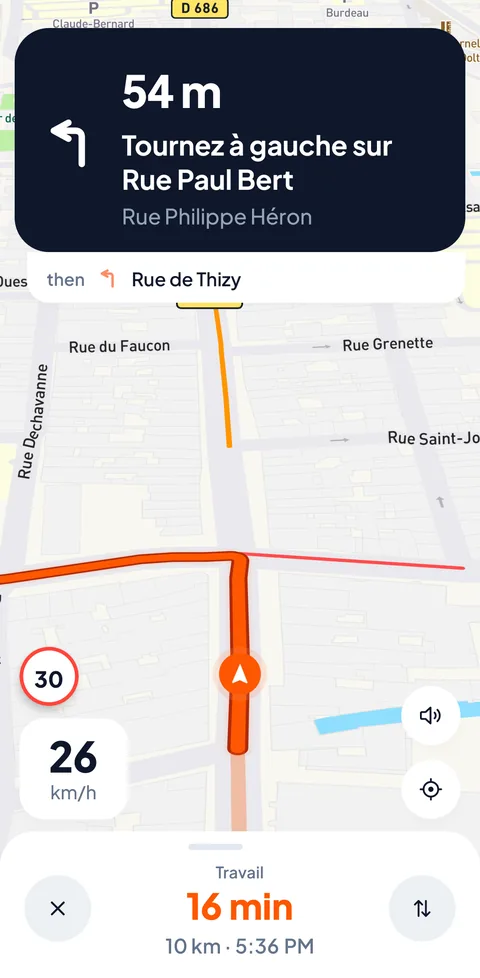
Having a good vehicle is not enough. You also need a GPS that understands your constraints. Many license-free car drivers, including those with electric models, run into difficulty here.
Google Maps and Waze calculate routes based on normal speeds: 50 km/h in town, 80 km/h on roads, 110 km/h on expressways. When they offer you a “shortcut” via an 80 km/h secondary road, they do not know you will be travelling at 45 km/h. The result: journey times that are systematically wrong (up to 50 percent out), and sometimes routes that take you onto roads where travelling at 45 km/h is dangerous.
This is exactly the problem TacTac solves. Its routing engine is calibrated for a maximum of 45 km/h, natively excludes expressways and ring roads, and calculates realistic journey times. To understand why standard GPS devices do not suit license-free cars and what a dedicated GPS changes in practice, read our guide GPS for license-free cars.
Conclusion: Which Model to Choose?
In 2026, there is no longer a good reason to buy a new petrol license-free car, unless your budget is very tight and you live outside any low-emission zone. For everyone else, electric is more economical over time, simpler to maintain, and freer in the city.
The choice between models comes down to three questions:
- Is your maximum budget 10,000 euros? Citroen Ami or Fiat Topolino, without hesitation. The best utility-to-price ratio on the market.
- Do you cover more than 40 km a day? Mobilize Duo for range, or Ligier e-JS60 for comfort.
- Do you want maximum comfort? Aixam e-City, with its proper cabin and dealer network across France.
To compare all models in detail, new prices, used prices, and financing, see our full license-free car comparison tool. And if you are still undecided between electric and petrol, our dedicated page on electric license-free cars will help you choose.
Join TacTac, the GPS designed for license-free car drivers, electric or petrol.