The license-free car (license-free car) is no longer a niche vehicle. With more than 50,000 registrations per year in France, it has established itself as a fully fledged mobility solution, whether you are 14 or 80, whether you live in a city center or in a rural area. This guide reviews everything you need to know in 2026.
What is a license-free car?
A license-free car is a light powered quadricycle, classified in the L6e category. Contrary to what its name suggests, it does not entirely exempt you from a licence: people born after 1 January 1988 must hold the AM licence (formerly the BSR) to drive one. Anyone born before that date can drive one without any licence at all.
Its technical specifications are governed by European law:
- Maximum speed: 45 km/h
- Engine displacement: 50 cm³ (diesel) or a maximum power of 6 kW (electric)
- Unladen weight: 425 kg maximum (excluding batteries for electric models)
- Seats: 2 maximum
Who can drive a license-free car?
Teenagers from age 14
Since 2014, young people have been able to drive a license-free car from the age of 14, provided they obtain the AM licence. This 8-hour course is delivered by an approved driving school. It is a mobility option that appeals to more and more families, especially in rural areas. All the details are in our article License-free cars at 14: what parents need to know.
Adults without a category B licence
Whether you have never taken the driving test or your licence has been suspended, the license-free car remains accessible. People born before 1988 need no driving permit. Everyone else simply needs to hold the AM licence.
Which roads are permitted?
This is the crucial point, and often the least understood. A license-free car is forbidden on motorways, expressways, ring roads and bypasses, on any road where the imposed minimum speed exceeds 45 km/h.
A standard GPS makes no distinction between a regular car and a license-free car: it can guide you onto a dual carriageway at 110 km/h without any warning. The consequences range from a fine (up to 1,500 €) to fatal danger. It is precisely to solve this problem that TacTac was designed. More details in our article on roads forbidden to license-free cars.
How much does a license-free car cost?
New: from 8,000 € to 19,000 €
- Entry level (Citroën Ami, Fiat Topolino): 8,000 € to 9,000 €
- Mid range (Aixam e-City, Ligier Myli): 11,000 € to 14,000 €
- Top range (Aixam Coupé GTI, Chatenet CH40): 15,000 € to 19,000 €
Used: from 4,000 € to 9,000 €
The used market is very active. Budget between 4,000 € and 9,000 € for a recent model in good condition. Watch out for maintenance costs on older diesel models, and always check the service record.
Additional costs
- Insurance: 20 € to 70 € per month depending on the profile and the cover
- Maintenance: 300 € to 600 € per year
- Electric charging: about 1.50 € for 75 km (at home)
The leading brands and models in 2026
Aixam, the historic leader
Aixam dominates the French market with nearly 40% market share. The range covers every budget, from the City Pack to the e-Coupé GTI Premium. Recognised reliability, a dense dealer network.
Ligier, the sporty challenger
Coming from the world of motor racing, Ligier offers models with a bolder design. The Myli and the JS60 appeal to a younger, more urban clientele.
Citroën Ami, the phenomenon
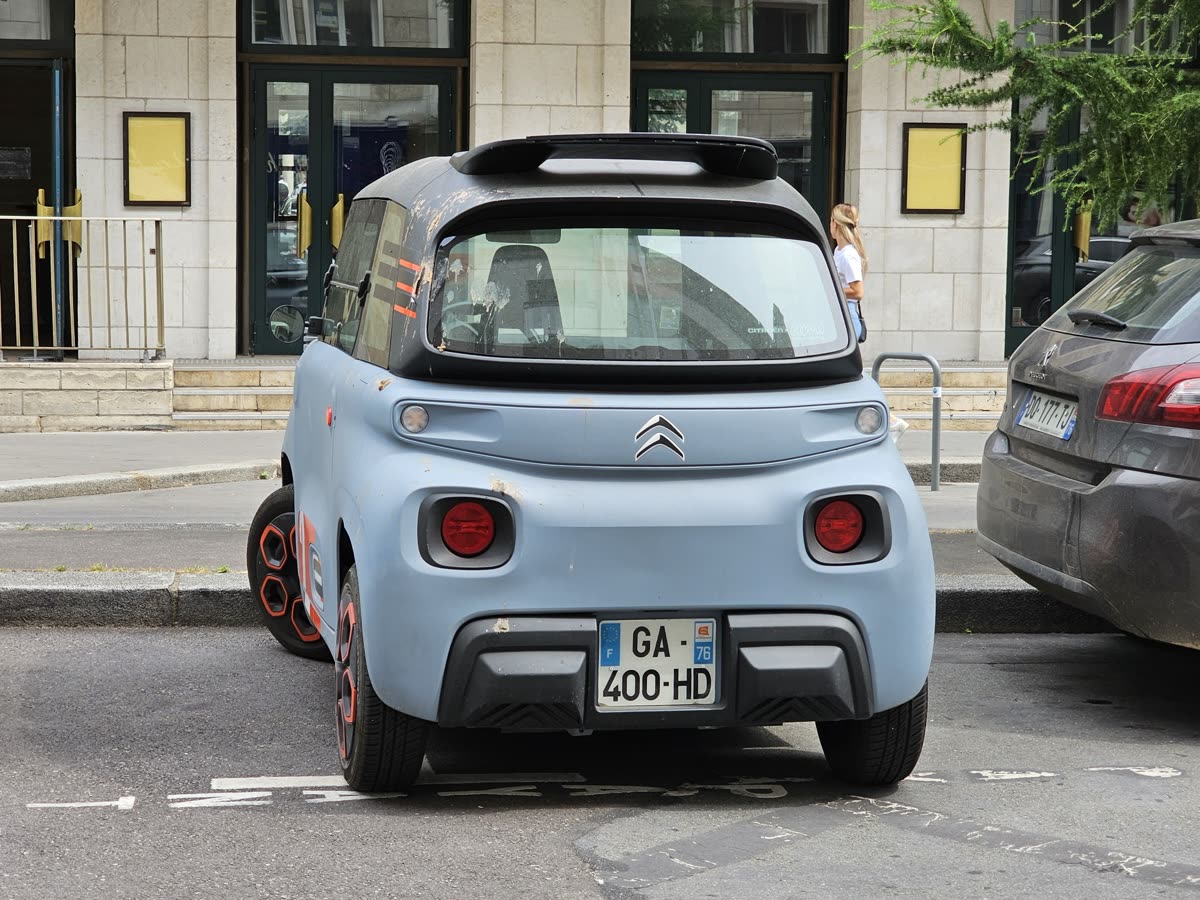
With its cube-shaped design and aggressive price (starting at 8,190 €), the Citroën Ami democratised the electric license-free car. Sold in retail stores (Fnac, Darty) as much as in dealerships, it upended the market’s conventions. Our Ami vs Topolino comparison details its strengths and weaknesses.
Fiat Topolino, the Italian competitor
A direct response to the Ami, the Fiat Topolino bets on a carefully crafted retro design and a similar pricing position (7,990 €). The Dolcevita variant, a convertible, makes it an object of desire for young drivers.
Microcar and Chatenet
These two historic French brands continue to offer reliable, well-equipped models, with a clientele that is often older and loyal.
Electric or diesel: which to choose in 2026?
In 2026, sales of electric license-free cars surpass those of diesel models for the first time. Here are the points of comparison:
| Criterion | Diesel | Electric |
|---|---|---|
| Range | 300-400 km | 60-100 km |
| Cost per km | ~0.06 € | ~0.02 € |
| Maintenance | More frequent | Minimal |
| Noise | Audible | Almost silent |
| Purchase price | 9,000 to 16,000 € | 8,000 to 19,000 € |
| LEZ restrictions | Potentially excluded | Always permitted |
For daily urban use (less than 50 km a day), the electric model is the most rational choice. Charging is done from a household socket in 3 to 4 hours, and the running costs are unbeatable. For longer trips in rural areas, diesel retains an advantage in range, but low-emission zones (LEZ) could quickly limit their access to city centers.
Navigating in a license-free car: the daily challenge
The biggest challenge behind the wheel of a license-free car is neither speed nor comfort: it is navigation. Mainstream GPS apps (Google Maps, Waze, Apple Maps) do not factor in license-free car constraints. The result: drivers regularly find themselves on forbidden roads, in stressful and dangerous situations.
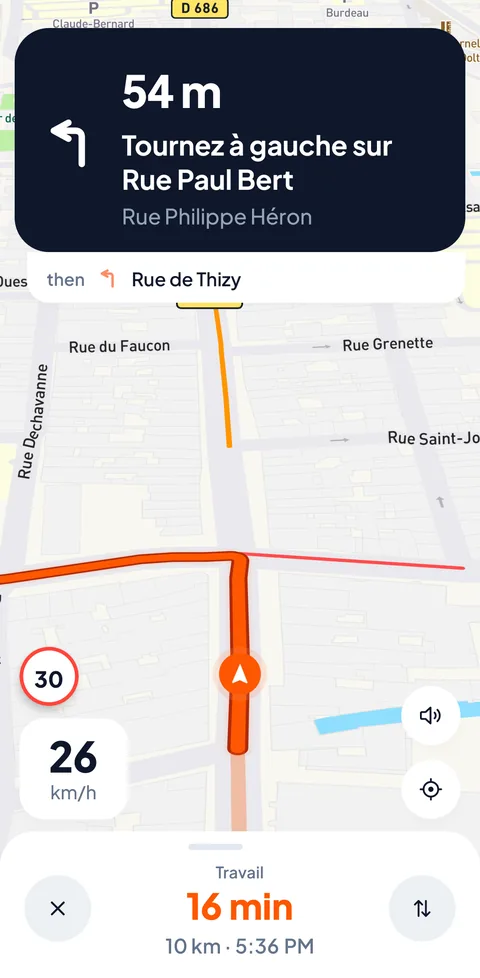
TacTac is the first GPS designed exclusively for license-free cars. It automatically filters out forbidden roads, calculates routes optimised for 45 km/h and provides voice guidance adapted to light quadricycles.
What to remember
The license-free car is a mature, accessible and increasingly capable mobility solution. Whether you are the parent of a 14-year-old, an adult looking for an alternative or a driver whose licence has been suspended, the license-free car deserves serious consideration. The main point to watch remains navigation: driving safely on the right roads is fundamental.
Join the TacTac waiting list and be among the first to navigate with peace of mind in a license-free car.