
The question comes up often on license-free car driver forums: can you really make a long trip in a license-free car? The answer is yes, provided you prepare well. It is not the same experience as in a standard car, but with the right reflexes, covering 100, 150, even 200 km in a license-free car is entirely possible.
Realism first: calculating your travel time
The first mental adjustment to make is on travel times. At a maximum speed of 45 km/h, and with a real average around 35-40 km/h when you account for village crossings, traffic lights and slowdowns, the calculations change radically.
A few useful benchmarks:
- 50 km = about 1h15-1h30
- 100 km = about 2h30-3h00
- 150 km = about 3h45-4h30
If your standard GPS announces 1h20 for 100 km, multiply by 2. This simple rule avoids nasty surprises and lets you plan breaks, meals and arrival times realistically.
Choosing the right roads: the key to a successful trip
The roads permitted for license-free cars
License-free cars can drive on almost the entire ordinary road network:
- Communal roads and connecting routes: ideal, little traffic
- Departmental roads (D) limited to 80 km/h: permitted, but to be chosen with care (mixed traffic)
- Ordinary national roads (N): permitted in most cases
The roads to avoid at all costs
- Motorways: forbidden, without exception
- Expressways and dual carriageways at 110 km/h: forbidden
- Urban ring roads: generally forbidden or very dangerous
- Certain suburban fast roads limited to 90 km/h with a central divider: to be checked case by case
The practical rule: if the road carries a motorway start sign (blue with a car silhouette), or if it is a dual carriageway with a central reservation and a speed above 80 km/h, go another way. Literally.
Favour quiet “D” departmental roads
For a long trip, the best roads are often the old national roads reclassified as departmental ones: wide, well maintained, passing through small towns with a few traffic lights. Lorry traffic there is limited, car speeds are reasonable, and motorists can overtake you without difficulty.
Managing electric range: the specific challenge
If you drive an electric license-free car (Citroën Ami, Fiat Topolino, Aixam e-City, Microcar M.Go Electric), range is your main constraint on a long trip.
The official ranges to keep in mind:
- Citroën Ami: 75 km (WLTP)
- Fiat Topolino: 75 km (WLTP)
- Aixam e-City: 100 km (WLTP)
- Microcar M.Go Electric: 90 km (WLTP)
In real conditions (terrain, variable speed, outside temperature), count on 60 to 80% of these figures. In cold weather (below 10°C), the range can drop by 20 to 30%.
Planning charging stops
The good news: an electric license-free car charges from any standard household socket (230V). No need for a fast charger, no compatibility to check. A 16A socket (standard) charges a Citroën Ami in 3h30.
For a 150 km trip with an Ami, plan a charging break of 2 to 3 hours halfway through. The practical options:
- A bar or restaurant with an accessible socket (ask politely, most establishments agree)
- A campsite or rural hotel: almost always equipped with outdoor sockets
- Slow AC charging stations in the market squares of many towns (Belib’, Freshmile networks, etc.)
- A socket at friends’ or relatives’ homes along the way
Combustion license-free cars obviously do not have this problem: an 8-10 litre tank lasts 400 to 500 km.
Breaks: a rhythm to respect
At 45 km/h, you spend more time in the vehicle than in a standard car for the same distance. Driving fatigue sets in faster, not because of the speed but because of the concentration and the length of time sitting still.
Recommendation: a 15-20 minute break every 1h30 to 2h. That is enough to stretch, drink something and get back on the road in good condition. For a 150 km trip (3h30-4h), plan two breaks.
Take the opportunity to check your levels (water, tyre pressure) if you are driving a combustion model, and to recharge a little if your license-free car is electric.
Examples of routes that work in a license-free car
Paris-Chartres (~90 km, ~2h30)
Leave Paris via the N10 (towards Versailles, then Chartres). After Trappes, the road becomes a fine departmental route across the Beauce. No fast roads, reasonable traffic, town crossings. Plan a break at Rambouillet.
Bordeaux-Arcachon (~60 km, ~1h45)
The D650 runs along the Arcachon Basin, passing through La Teste-de-Buch. A flat, pleasant route, with a few slowdowns in season. Perfect for a day at the sea in a license-free car.
Nice-Antibes (~25 km, ~45 min)
The Promenade des Anglais then the seafront via Cagnes-sur-Mer. Dense but slow traffic, speeds compatible with a license-free car in a coastal city. Watch out for certain stretches of the RN7 to check.
Lyon-Pérouges (~35 km, ~1h)
Via the D65 from Meyzieu. A quiet country road, crossing villages with an arrival in the old medieval town. Ideal for a weekend in a license-free car.
TacTac: the tool designed for this kind of trip
Preparing a license-free car route manually takes time. You have to check each stretch on Google Maps, identify the dual-carriageway sections, find the alternatives, then calculate a realistic ETA at 45 km/h. It is doable, but tedious.
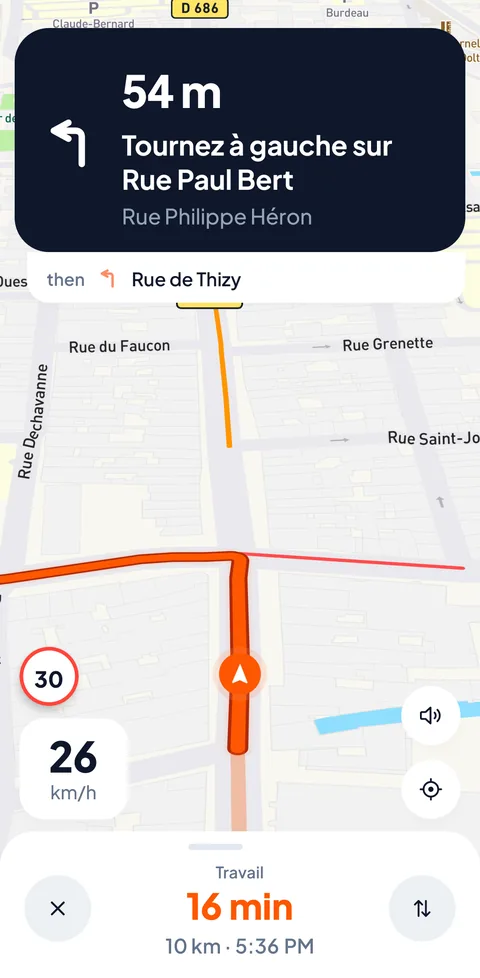
TacTac automates all of that: routes calculated exclusively on roads permitted for license-free cars, arrival estimates based on a real speed of 45 km/h, and for electric license-free cars, the integration of range constraints to suggest the right breaks.
In summary
A long trip in a license-free car is entirely achievable if you accept three constraints: longer travel times, routes that avoid fast roads, and for electric models, proactive management of range. With the right preparation, driving 150 km in a license-free car becomes a pleasant experience, you see the landscape, you pass through villages, you take your time.
Join the TacTac waiting list to plan your next trips without worrying about forbidden roads.