Fatima is 34. Her licence was revoked six months ago after losing too many points. She has just picked up a second-hand Ligier IXO, the first license-free car of her life. On the Saturday morning of her first outing, she sits parked outside her home for twenty minutes. No mechanical panic. Just the strangeness of setting off in a car she does not know, on roads she will see differently. This guide is for her, and for everyone about to experience that same first departure.
AM licence: what you need to know before getting behind the wheel
A license-free car is a light motor quadricycle, category L6e. To drive one legally:
- If you were born before 1 January 1988: no driving licence is required. You can drive immediately.
- If you were born after 1 January 1988: the AM licence (formerly BSR) is compulsory. It is obtained at a driving school after a minimum 7-hour course, most often over half a day. Cost: 250 to 400 euros depending on the school.
- In the event of a B licence revocation: check explicitly whether the judicial or administrative decision extends to light quadricycles. In many cases it does not specify this, and the license-free car remains accessible.
If you have any doubt about your situation, ask your prefecture directly or consult a lawyer specialising in road law. Do not get behind the wheel until you have clarified this point.
Getting comfortable: the first 30 minutes that matter
Before your first trip on the road, spend at least 20 to 30 minutes getting used to the vehicle somewhere quiet: an empty car park, an industrial estate on a Sunday morning, or a large private property.
What is different from a conventional car
CVT transmission. The vast majority of petrol-powered license-free cars have no manual gearbox. The transmission is automatic (CVT, variable belt). There is no clutch pedal. You have only an accelerator, a brake, and a gear selector (forward, neutral, reverse). The first manoeuvres are often disorienting: the vehicle responds differently from a conventional automatic, with a slight lag on acceleration.
Turning circle. License-free cars have a tight turning circle, which is an advantage in town. But the first U-turns take a few attempts to calibrate distances properly.
Dimensions. A license-free car is approximately 2.50 m long and 1.50 m wide. That is noticeably smaller than a conventional car. This sense of “smallness” is reassuring when parking, but it can throw off your first spatial judgements on the road.
Braking. The brakes on a license-free car are sized for a light vehicle. They are effective, but their feel differs from heavier cars. Try several progressive stops before driving on an open road.
The road at 45 km/h: the psychology of slow driving
This is the aspect nobody tells you about upfront, yet it is the most important one: driving at 45 km/h when the rest of traffic is doing 80 km/h is a mental experience all of its own.
In the first few days, you will feel a diffuse social pressure. Cars will overtake you. Some drivers will be impatient. Horns may sound. None of this is a legal problem; you are driving within your rights, at the maximum speed permitted for your vehicle.
What helps in practice:
- Stay to the right when the road allows, so faster cars can overtake without being forced.
- Anticipate junctions earlier than in a conventional car. At 45 km/h, you have less room for late decisions.
- Do not try to go faster. The 45 km/h limit is not a target to reach; it is a ceiling not to exceed. On slippery roads or in bad weather, driving at 35-40 km/h is perfectly normal.
After a few days, the speed becomes natural. Most license-free car drivers report feeling calmer behind the wheel than when they held a B licence.
Which roads to avoid in the first few days?
Roads to steer clear of at first
- 80 km/h roads with heavy traffic: the speed difference from other vehicles is stressful and leads to close overtaking. Wait until you feel comfortable before using them.
- Complex multi-lane roundabouts: start with simple single-lane roundabouts.
- Narrow roadworks zones: reduced clearances can catch you out.
- Mountain roads without crash barriers: at 45 km/h, descents can feel faster than expected if you have not yet calibrated engine braking on your license-free car.
Ideal roads for beginners
- Secondary roads and local roads (marked C + number) at 50-60 km/h
- Town streets in 30 or 50 km/h zones
- Business parks in the morning
- Quiet country lanes with little traffic
Safety habits to build from the start
Blind spots. Despite the compact size of license-free cars, mirrors are sometimes small. Turn your head before every change of direction or lane; the reflex is the same as in a conventional car.
Night-time visibility. Entry-level license-free cars have less powerful headlights than conventional vehicles. Outside town at night, the light reach is limited. Adjust your speed accordingly, even if you are well below the 45 km/h ceiling.
Stability in crosswinds. License-free cars are light (350 to 500 kg). In strong side winds, the handling differs from a heavier vehicle. Reduce your speed and hold the wheel firmly.
Following distance. It remains the same as in a conventional car: 2 seconds from the vehicle ahead. At 45 km/h, that is around 25 metres.
Choosing your routes in the first few days: a simple method
Before setting off, mentally map your route by asking yourself three questions:
- Are there sections above 70 km/h on the direct route? If so, is there an alternative via secondary roads?
- Does the route pass through roadworks zones or roads with little clearance? Anticipate alternatives.
- What is the real journey time at 45 km/h? A 15 km trip in a conventional car (15 minutes at 80 km/h) will take around 22 to 25 minutes in a license-free car. Factor this reality into your planning.
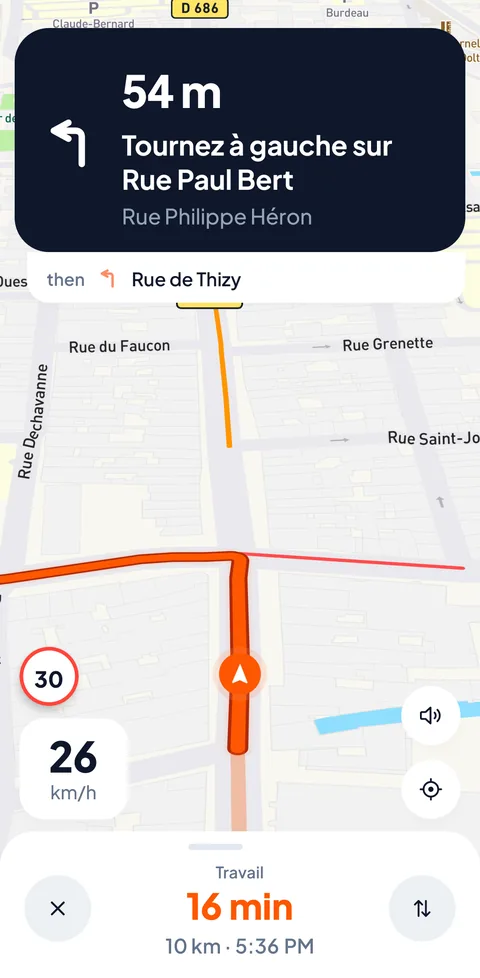
General-purpose GPS apps (Google Maps, Waze) calculate routes for vehicles travelling at normal traffic speeds. They may send you onto roads unsuitable for a license-free car, and the journey times they show will consistently be underestimates.
The value of a GPS built for license-free cars
The one tool that solves the route-choice problem is a GPS designed specifically for license-free cars.
TacTac calculates filtered routes for license-free cars: quiet roads, exclusion of expressways and roads forbidden to light quadricycles, journey times calculated at 45 km/h. From the very first days, this changes the confidence with which you set off. You do not have to mentally “check” each section of the route; the app does it for you.
For a driver returning to the road after a licence revocation, or discovering day-to-day life in a license-free car for the first time, this makes a concrete difference.
What changes after the first two weeks
Most beginner license-free car drivers describe the same arc: the first five or ten trips are marked by intense concentration, sometimes tension. Then something relaxes. Distances start to feel natural, manoeuvres become fluid, and the slow pace no longer feels like a constraint.
By the third or fourth week, many say they no longer remember why they hesitated before starting out.
A license-free car is not a degraded substitute for a real car. It is a vehicle in its own right, with its own rules, advantages, and limits. Understanding this from the start is what makes driving a pleasure rather than a chore.