Short answer: in the UK, a court disqualification stops you driving any motor vehicle on a road, and a light quadricycle is a motor vehicle. A licence-free car is not a way round a ban. France works differently, and the rules there depend on your year of birth.
Warning: this is general information checked against legislation.gov.uk, GOV.UK, Légifrance and Service-Public in October 2026. It is not legal advice. Your own order or decision is what counts, so have a motoring solicitor (or, in France, an avocat) read it before you get behind the wheel of anything with an engine.
What licence does a light quadricycle need in the UK?
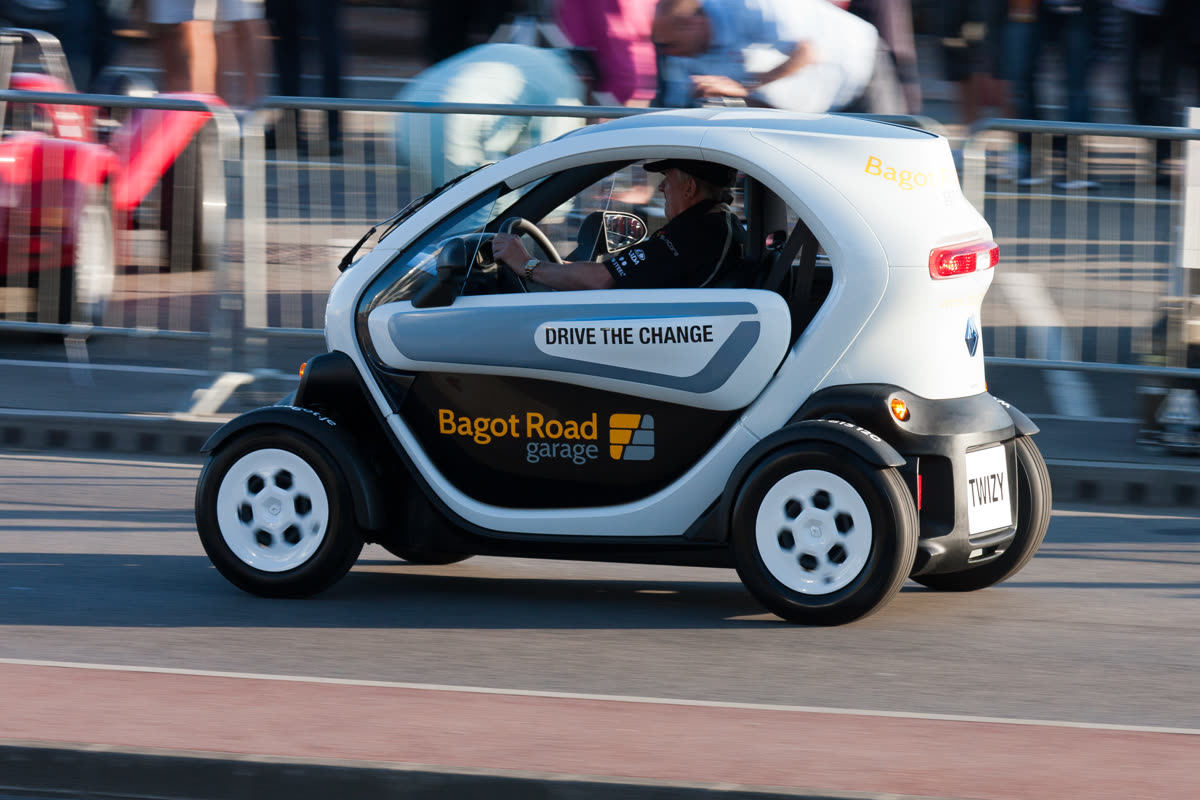
A “licence-free car” is the French name for a light quadricycle: a small four-wheeled vehicle limited to 45 km/h. In Britain it is not licence-free at all. GOV.UK lists light quad bikes under category AM, with a mass in running order of not more than 425 kg (batteries excluded for electric models) and a maximum design speed above 25 km/h but not more than 45 km/h. The minimum age for category AM is 16. If you hold a full car licence, check whether category AM appears on it; our AM licence guide explains how the categories fit together.
The point that matters here: you drive a light quadricycle on the strength of a licence. Lose the licence and you lose the right to drive the quadricycle.
Can you drive a quadricycle while disqualified?
Three provisions answer the question, and they leave little room for doubt.
Section 103(1) of the Road Traffic Act 1988 makes it an offence, “while disqualified for holding or obtaining a licence”, to obtain a licence or to “drive a motor vehicle on a road”. The offence is about motor vehicles in general, not cars.
Section 185(1) of the same Act defines a motor vehicle as “a mechanically propelled vehicle intended or adapted for use on roads”. A light quadricycle, whether petrol, diesel or electric, fits that description.
Section 37(1) of the Road Traffic Offenders Act 1988 adds that when a licence holder is disqualified by a court, “the licence shall be treated as being revoked” from the start of the ban. Your AM entitlement sits on that same licence, so it goes too.
Disqualifications usually follow section 34 of the Road Traffic Offenders Act 1988 (obligatory bans, for example drink driving) or section 35 (the “totting up” ban for 12 or more penalty points within three years). Both disqualify you for holding or obtaining a licence, which is the wording section 103 targets.
The exception: bans limited to one class of vehicle
Section 103(6) covers a person whose disqualification is limited to motor vehicles of a particular class, for example a disqualification until a test is passed under section 36 of the Road Traffic Offenders Act. Only then does the offence shrink to that class. Section 37(3) also lets someone disqualified until they pass a test hold a provisional licence and drive under its conditions. If you think either situation applies to you, the wording of your court order decides it, and a solicitor should confirm it before you drive.
Penalties for driving while disqualified
For England and Wales, Schedule 2 to the Road Traffic Offenders Act 1988 sets the following for section 103(1)(b):
- up to 6 months’ imprisonment, a level 5 fine (unlimited in England and Wales) or both;
- 6 penalty points;
- a further disqualification at the court’s discretion.
In Scotland the case can also be tried on indictment, with a maximum of 12 months.
UK situations at a glance
| Your situation | Light quadricycle on a road? | Source |
|---|---|---|
| Court disqualification (s.34 or s.35 RTOA) | No | RTA 1988 s.103(1) and s.185(1); RTOA s.37(1) |
| Disqualified until you pass a test (s.36 RTOA) | Only under provisional licence conditions, if your order allows | RTOA s.37(3); RTA s.103(6) |
| Ban limited to one class of vehicle | Depends on the class named in your order: ask a solicitor | RTA s.103(6) |
| Licence revoked by the DVLA (new driver, medical) | Only with a licence covering that class: ask the DVLA | RTA s.87(1) |
| Valid licence with category AM or B | Yes, subject to the usual rules | GOV.UK licence categories |
The DVLA revocation row is deliberately cautious. The sources we checked do not say, case by case, which entitlement survives a revocation, so we will not guess.
Licence-free car with a suspended licence: if you live in France
French law treats the “voiture sans permis” differently, and the corrected French version of this article sets out the texts. In brief:
- Under article R211-2 of the Code de la route, a driver born before 1 January 1988 needs no licence at all to drive a light quadricycle. A suspended category B licence does not stop them, as long as no other ban applies.
- A driver born on or after 1 January 1988 needs the AM category (the former BSR), which is carried on the same licence as category B. While that licence is suspended, it cannot be used to drive a light quadricycle. Service-Public says that after a court suspension that does not cover light quadricycles, or after a licence invalidated for zero points, you can apply to the ANTS for a licence showing category AM alone. For a prefect’s suspension or a cancellation, no official source we read settles the point.
- A French court can add a ban on driving “certain land motor vehicles, including those for which a driving licence is not required”, for example under article L234-2 (drink driving) or article L224-16. If your judgment includes it, your year of birth no longer matters.
- Article L224-16 punishes driving a vehicle that requires a licence despite a suspension with two years’ imprisonment and a 4,500 euro fine.
For anything outside those cases, ask the préfecture or an avocat specialising in road traffic law, in writing if you can.
Before you drive anything
- Read your order or decision: is it a full disqualification, or limited to one class of vehicle?
- Check the date it ends. GOV.UK says that after a ban of 56 days or more you must apply for a new licence before driving again; under 56 days you do not.
- Ask a motoring solicitor if the wording leaves any doubt.
- In France, compare your date of birth with 1 January 1988 and look for a court ban covering vehicles that need no licence.
Once your right to drive is back, the practical rules of light quadricycles still apply: a 45 km/h maximum and the roads that are closed to them. Our pages on roads closed to licence-free cars and insuring a licence-free car cover the next steps.
Sources
- Road Traffic Act 1988: section 103, section 185, section 87
- Road Traffic Offenders Act 1988: section 34, section 37, Schedule 2, Part I
- GOV.UK: driving licence categories, moped and motorcycle categories and ages, driving disqualifications
- France, Code de la route: article R211-2, article L224-16, article L234-2