The license-free car has a bad reputation. It is often dismissed as a toy, a kid’s thing, not a real vehicle. Yet when you compare the numbers, the license-free car is significantly safer than a moped or a 50cc scooter. Fewer serious accidents, fewer serious injuries, far superior protection in a collision.
That does not mean every risk disappears. Dangers exist, but they are specific and, for the most part, avoidable with good habits and the right tools (our license-free car vs scooter safety page details the figures and the protections).
Risk 1: ending up on a forbidden road
This is the most serious danger and by far the most frequent. A license-free car is limited to 45 km/h. On a road where the rest of traffic moves at 110 or 130 km/h, the speed differential creates a risk of fatal accident, no matter how careful the driver is.
How it happens
A young driver opens Google Maps, follows the voice instructions, and ends up on an expressway slip road. Or they take a habitual route but follow a diversion signed at the last moment that leads onto a high-speed national road. Sometimes it is simply a misread sign or ambiguous signage in the middle of the night.
Google Maps, Waze, and standard GPS apps make no distinction between a normal car and a license-free car. They calculate the fastest route, regardless of restrictions linked to the vehicle category.
The consequences
A license-free car on a motorway or expressway is a breach of the Highway Code, punishable by a 1,500-euro fine and vehicle immobilisation. Beyond the administrative penalty, it is above all a serious accident risk: a heavy goods vehicle at 90 km/h overtaking a license-free car at 45 km/h creates a speed differential that leaves very little margin for error.
The solution
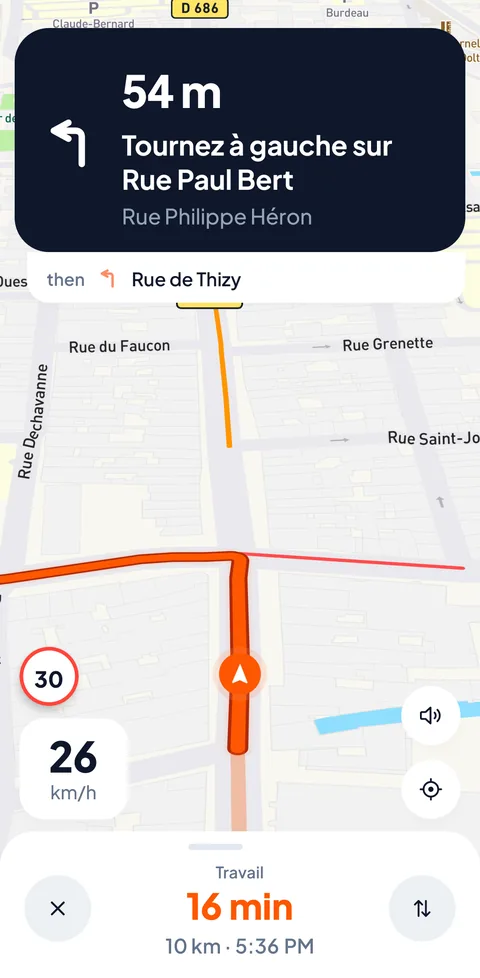
TacTac automatically filters all these roads before even starting to calculate a route. No expressway, no motorway access, no high-traffic road forbidden to light quadricycles. The teenager follows the voice instructions without needing to memorise every local restriction.
Risk 2: lack of driving experience
At 14 years old, you do not yet understand the real physics of a moving vehicle. That is not a flaw; it is simply a matter of experience.
Braking distances on wet roads
A license-free car at 45 km/h on a wet road stops in around 20 to 25 metres with normal reactions. A young driver who has never felt the wheels slip slightly under braking will often react too late or brake too hard. The recommended safety distance, the equivalent of two seconds of travel, seems excessive until the day it saves you.
Blind spots of large vehicles
A lorry or bus has significant blind spots on both sides and at the rear. A quiet license-free car filtering alongside a heavy goods vehicle at a junction may be entirely in a blind spot without the driver being aware of it. The habit of never stopping in the lateral zone of a lorry is something that comes with time.
Practical tips: maintain at least a three-second gap behind the vehicle ahead, never exceed the 45 km/h limit even when the road looks clear, and start on low-traffic roads before tackling busier routes.
Risk 3: GPS distraction
A young driver glancing at their phone to follow Waze does not have their eyes on the road. Even two seconds of looking down at 45 km/h means covering 25 metres without seeing what is happening ahead.
Voice guidance changes everything
A GPS with voice guidance keeps hands on the wheel and eyes on the road. The difference from a phone propped on the dashboard is real: there is no map to decipher, just instructions to listen to and follow.
TacTac was designed with this use case in mind. Voice guidance is calibrated for license-free car drivers discovering new roads: instructions are anticipated early enough not to surprise a driver still getting used to quick manoeuvres.
What the license-free car offers in terms of protection
There is no point ending on a catalogue of risks without recalling why the license-free car remains a relevant choice for a first vehicle.
Structural protection far superior to two-wheelers
Body, seatbelt, four wheels: even without an airbag, a license-free car protects infinitely better than a 50cc scooter in a collision. Road safety statistics are clear: accidents involving mopeds generate approximately five times more seriously injured people than accidents involving license-free cars at comparable mileage.
European L6e type approval
All license-free cars sold in Europe must meet the L6e standard, which imposes structural safety tests. Impact resistance, chassis strength, brake performance: these are not cosmetic criteria. A new 2024 or 2025 model meets requirements far stricter than those for the first generations of license-free cars from the 2000s.
Practical tips for parents
The safety of a young license-free car driver is built before the first solo journey.
Make the first trip together. Not as a silent passenger, but by commenting on what you see: the right-of-way rules, the tricky spots on the route. That first shared drive identifies difficult angles, poorly signed intersections, and areas to avoid.
Establish clear route rules. No high-traffic roads, no night-time driving during the first few weeks, known routes before exploring new ones. A defined perimeter is not a punishment; it is a logical progression.
Configure TacTac with exclusion zones. The app allows you to add specific exclusion zones: a complex road interchange near home, a stretch that inevitably leads toward a fast road. That setup is done once and applies to every route calculated.
In summary
Risks exist in a license-free car, but they are identifiable and largely preventable. The forbidden-road risk is the most serious, and it is precisely the one TacTac eliminates by design, by only calculating routes suited to light quadricycles.
For a first vehicle at age 14, the combination of a license-free car, a dedicated GPS, and clear driving rules represents the safest approach available. Far safer than any motorised two-wheeler.
Sign up to TacTac so your teenager always drives on routes suited to their license-free car.